If your website is not converting visitors, you are not alone — and the reason is rarely what you think. Most business owners assume they need more traffic. But the psychological reasons why websites fail to convert are far more powerful than any traffic strategy. When visitors leave without contacting you, signing up, or requesting a quote, your website is failing at its primary job.
In most cases, the problem is not traffic. The problem is conversion. When a website is not converting visitors, the underlying issue usually comes from unclear messaging, weak calls-to-action, poor user experience, mismatched traffic, or lack of trust signals. Understanding these issues can help businesses transform passive traffic into real leads and customers.
The Core Psychological Problem: Why Visitors Don’t Convert
Understanding the psychology of conversion — how visitors think, feel, and make decisions — is the real key to fixing a low conversion rate. Most websites struggle not because of design or visibility, but because they ignore how the human brain responds to messages, decisions, and trust.
When business owners notice their website is not converting visitors, they often assume the solution is to increase traffic. While traffic matters, it is only one piece of the puzzle.
Visitors must move through a simple journey:
Interest → Trust → Action
If any step in that process breaks down, visitors leave without converting. Most websites struggle because they focus on design or visibility rather than a conversion strategy. Below are the most common reasons websites fail to convert visitors.
1. Your Website Is Not Converting Visitors Because the Value Proposition Is Unclear
Visitors decide within seconds whether your website is relevant to them. If your messaging is vague or generic, they will leave quickly.
Many websites use headlines such as:
- “Professional services for your business”
- “We deliver innovative solutions”
- “Your trusted partner”
Although these phrases sound professional, they fail to answer the most important visitor question:
Why should I choose you?
A strong value proposition clearly explains:
- What you offer
- who you help
- What makes you different
For example:
Instead of saying: “Digital marketing services.”
You could say: “Helping small businesses generate consistent leads through SEO and targeted advertising.”
Clear messaging immediately improves website conversion rates because visitors understand the benefit. This is one of the most common psychological barriers to conversion — visitors cannot buy what they cannot clearly picture.
2. Why Your Website Gets Traffic but No Leads
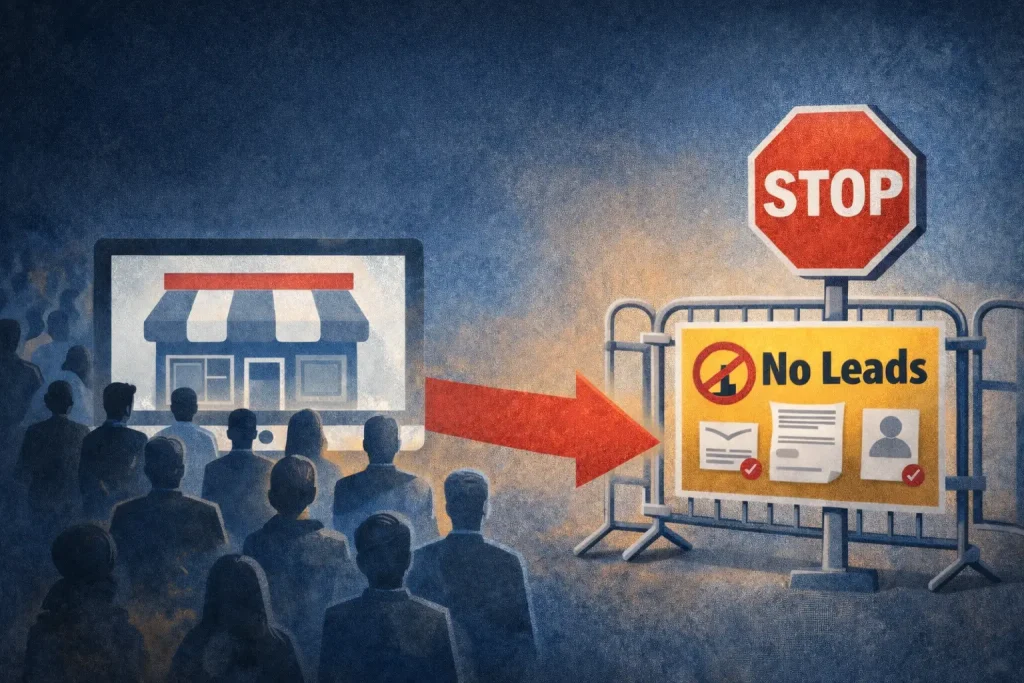
Another common situation occurs when businesses see traffic growth but still struggle with conversions. In other words, the website gets traffic but no leads. This often happens because the traffic does not match buying intent.
Psychologically, this is a mismatch of intent. Visitors arrive with one mindset, but your page speaks to a different one. Your conversion copywriting must match where the visitor is in their decision journey — not where you want them to be.
For example, someone searching:
“What is SEO?” ~ is usually researching.
Meanwhile, someone is searching:
“SEO services for small businesses” ~ is much closer to hiring a provider.
If your website attracts visitors who are not ready to act, conversion rates remain low. – To solve this problem, businesses must align their content and advertising with high-intent search queries. Targeting the right audience dramatically improves the chances of turning visitors into leads.
3. Your Website Is Not Converting Visitors Because Calls-to-Action Are Weak
Here’s a psychological truth: people hate making decisions. Research on decision fatigue shows that the more choices a visitor faces, the less likely they are to act at all. Your CTA must remove that mental friction — not add to it.
Even interested visitors need clear direction. Unfortunately, many websites obscure their calls to action or make them confusing.
Common mistakes include:
- placing contact buttons only at the bottom of pages
- using vague wording like “learn more”
- offering too many choices
When visitors are unsure what action to take, they often do nothing. Effective calls-to-action clearly guide the next step.
Examples include:
- “Request a Free Consultation”
- “Get Your Website Audit”
- “Book a Strategy Call”
Strong CTAs leverage the psychology of direction — people follow clear instructions. This is high-direction conversion copywriting, and it’s one of the fastest ways to increase website conversions without changing your traffic.
4. Poor User Experience Prevents Visitors From Converting
From a psychological standpoint, frustration is the enemy of conversion. A slow or confusing website triggers what researchers call cognitive overload — and an overwhelmed visitor seldom converts.
User experience plays a major role in conversion performance. Even if visitors are interested in your offer, a frustrating experience will drive them away. Several issues frequently appear on websites that struggle with conversions.
These include:
- slow loading speed
- confusing navigation
- poor mobile optimization
- cluttered page layouts
Research shows that users abandon websites quickly when loading times exceed just a few seconds. Similarly, if visitors cannot find information easily, they rarely stay long enough to convert. Improving usability often leads to immediate improvements in website conversion rates.
Businesses should prioritize:
- fast loading pages
- clear navigation structure
- mobile-friendly design
- simplified layouts
These changes make it easier for visitors to explore and take action.
5. Your Website Doesn’t Build Know, Like, and Trust — So Visitors Don’t Convert
In marketing, the know-like-trust factor is the psychological foundation of every sale. Before anyone spends money, they need to feel they know who you are, like your approach, and trust that you deliver results. Without these three signals clearly present in your website copy, even interested visitors will leave to research competitors.
- Know – Is your messaging consistent with what they’ve already heard about you?
- Like – Does your website make visitors feel confident, inspired, or hopeful?
- Trust – Are you showing real results, real testimonials, and real expertise?
Common trust signals include:
- customer testimonials
- case studies
- Google reviews
- portfolio examples
- industry certifications
These elements reassure visitors that other people have successfully worked with your business. Without trust signals, even interested visitors may delay their decision. Adding authentic reviews or client success stories can significantly improve website conversions.
6. Your Website Conversion Funnel Is Too Complicated
Another overlooked issue is complexity. Some websites overwhelm visitors with too many options.
For example:
- multiple services are competing for attention
- long forms requesting unnecessary information
- crowded navigation menus
When visitors feel overwhelmed, they often leave instead of continuing the process. High-converting websites simplify the user journey. They guide visitors through a clear path:
problem → solution → action
Think of it like your ideal client’s internal monologue: they arrive with a problem, they need to see your solution clearly, and they need one obvious action step. When your website funnel is mapped to that mental journey, conversion rates improve dramatically. Reducing friction often improves conversion performance faster than increasing traffic.
7. You Are Not Tracking Conversion Data
When a website is not converting visitors, businesses must rely on data to identify the problem. Unfortunately, many companies do not track conversion metrics.
Important metrics include:
- website conversion rate
- cost per lead
- traffic sources
- bounce rate
- page engagement
Tracking this data helps identify where visitors drop off. For example, analytics may reveal that most visitors leave on a specific page. That insight allows businesses to improve messaging, layout, or calls-to-action. Companies that track data consistently make better marketing decisions and improve results over time. Without data, you’re guessing. And guessing is why so many businesses keep getting traffic but no leads, month after month.
8. Your Website Isn’t Selling the Client Transformation
People don’t buy your service — they buy the transformation your service gives them. This is one of the most overlooked psychological principles in conversion optimization.
A visitor landing on your website is not thinking: “I need a digital marketing package.”
They are thinking: “I need my business to grow. I want to stop worrying about leads. I want to feel like things are working.”
Sell the transformation, and your conversion rate will increase. You can do this by:
- Rewriting your testimonials to show a clear before-and-after result, not just a star rating.
- Replacing feature lists (“We offer SEO, ads, and analytics”) with outcome statements (“Clients typically see a 40% increase in qualified leads within 90 days”).
- Sharing your own story — if you have solved this problem yourself, say so. Visitors who see your transformation start believing theirs is possible.
When your website copy focuses on the result rather than the process, visitors stop seeing you as a vendor — and start seeing you as the solution they have been looking for.
How to Fix a Website That Is Not Converting Visitors
Once businesses understand the problem, improving conversion performance becomes easier. The most effective fixes usually involve improving clarity, trust, and user experience.
Map Your Customer Journey Before You Write a Single Word
One of the most effective conversion fixes is also the most skipped: mapping your customer journey. Before optimizing any page, you need to understand:
- What surface problem is your visitor trying to solve? (e.g. ‘I need more website leads’)
- What deeper frustration is driving them? (e.g. ‘I’ve spent money on ads and seen zero results’)
- What is the underlying goal? (e.g. ‘I want a business that gives me freedom, not stress’) When your website copy speaks to all three levels of that journey — surface, emotional, and philosophical
- your ideal clients feel like you are reading their mind. That’s when conversion rates increase, not from tricks, but from alignment.
When your website copy speaks to all three levels of that journey — surface, emotional, and philosophical — your ideal clients feel like you are reading their mind. That’s when conversion rates increase, not from tricks, but from alignment.
To increase conversions, businesses should:
- Clarify their value proposition
- Improve calls-to-action
- Target high-intent traffic
- Simplify the user journey
- Add trust signals such as testimonials
- Track conversion data regularly
These steps create a stronger conversion framework that turns traffic into leads.

Turning Website Visitors Into Business Opportunities
When a website is not converting visitors, the issue rarely comes from a single mistake. Instead, conversion problems usually result from multiple small gaps.
These gaps may include:
- unclear messaging
- weak calls-to-action
- low-intent traffic
- poor usability
- lack of trust
Fortunately, each of these issues can be fixed with the right strategy. Businesses that continuously optimize their websites often see steady improvements in conversion performance. Small improvements across several areas can dramatically increase the number of leads a website generates.
Frequently Asked Questions
Why is my website not converting visitors?
A website may not convert visitors because of weak messaging, poor calls-to-action, slow loading speeds, low-intent traffic, or a lack of trust signals.
What is a good website conversion rate?
Across many industries, the average website conversion rate typically ranges between 2% and 5%, although well-optimized landing pages can convert significantly higher.
How can I increase website conversion rates?
Businesses can increase conversion rates by improving their value proposition, adding strong calls-to-action, simplifying navigation, targeting high-intent traffic, and building trust with testimonials or case studies.
Final Thoughts
If your website is not converting visitors, the solution is rarely more traffic alone. Instead, businesses must focus on improving the conversion system behind the website. By strengthening messaging, improving user experience, building trust, and tracking performance data, companies can transform passive visitors into meaningful business opportunities.
Optimizing conversion is not a one-time task – It’s an ongoing process. However, businesses that commit to improving their website experience consistently generate more leads, better engagement, and stronger long-term growth.
If you want a professional review of why your website is not converting, get a free consultation.